Dont Talk to Me of My Son Again Hippie
I north a family home in moving picture-pretty Oxfordshire, iv women and seven toddlers are, respectively, drinking tea and causing anarchy. The children, anile between 13 months and four years, are doing what children of those ages do: quarrelling over toys and bellowing for their mothers. The women are discussing the kinds of things modern mothers hash out: the evils of sleep grooming, the joys of hypnobirthing. Rebecca, whose house nosotros are in, sets block down for her friends just every bit her 19-calendar month-old son toddles up to demand some milk.
"You're hungry again? OK," she says, shifting in a large armchair as she lifts her boy across her body and unbuttons her elevation. "You don't wake upwards and recollect, I'm going to breastfeed a toddler," she tells me. "Y'all but keep feeding your newborn. Sometimes I'll go somewhere and other people will look at me strangely. They'll make comments nigh him e'er hanging off me, merely then they say what a happy boy he is," she adds, every bit her son drinks contentedly, pausing only to switch sides. Xv minutes afterwards, he is back for more.
These women, who encounter every calendar week, refer to themselves as a tea-and-cake group, just they are likewise an attachment parents' group. An adjunct of "natural parenting", also known as gentle or off-grid parenting, or intensive mothering, this is the approach of the moment, merely every bit Gina Ford'south more than scheduled method (strict bedtimes, an unbreakable routine) was a decade ago; to a certain degree, it is the reaction of a new generation of parents against Ford and her ilk.
Zipper parenting harks back to the baby-focused 1970s, only with a more 21st-century, anti-authority bent. Mothers are urged to trust their instincts over the communication of professionals, and to shun developments such as sleep preparation (in which babies are left to cry to encourage them to sleep for longer) and, occasionally, vaccinations. Whereas parents were once encouraged to fit the baby into their schedule, an attached mother is led by her baby, responding to their demands immediately, or "respectfully". The approach combines an attitude of enlightenment ("We don't do things the old way") with veneration of the distant past (vague anthropological references to the practices of ancient tribespeople, never listen the improved female parent and baby mortality rates). If you are a woman anile between 25 and 45, you lot volition almost certainly accept seen people lauding this arroyo on social media; Facebook will soon take every bit many groups devoted to attachment parenting as it has gifs of cats.
Similar the trend for "health" and clean eating, attachment parenting posits that the mod world has corrupted what was in one case pure, through scientific intervention. Rejecting modernity has become the ultimate aspirational signifier, from fetishising cycling over driving to praising farmers' markets over supermarkets; after all, in order to reject something, you not only demand access to it, you have to take so many options, you don't even need information technology. It also has about it a touch of anti-intellectualism, an increasingly pop opinion in everything from politics to nutrition.
Attachment parenting was developed in the 1980s by the American paediatrician William Sears and his wife Martha, a registered nurse, now in their 70s, and starts from the inarguable position that loving parental interaction is benign to a child. The Sears' underlying contention is that, through a combination of modern life, misguided experts and selfishness, we have become emotionally detached from our children; parents demand consciously to rebuild that attachment. "Babies who are deprived of secure zipper do not abound well," the Sears write in The Attachment Parenting Book, first published in 2001. "They seem sad. Information technology's equally if they've lost their joy of living." Children raised the attachment way, by dissimilarity, are "caring and empathetic". Attachment is "a special bond… the mother feels complete only when she is with her infant". (Despite its seemingly inclusive name, zipper parenting literature is always directed at the female parent.)
Followers stress that zipper parenting isn't nigh rules, but about creating a special relationship – though it's a relationship that's built by post-obit specific tenets, including baby-wearing (carrying your infant in a sling or holding them as much as possible); long-term breastfeeding; co-sleeping (sharing the parental bed with your baby); e'er responding to your baby's cry, no affair how tired y'all are. You don't have to follow all the rules, but the Sears warn that you volition so have to work harder.
I get-go encountered zipper parenting when a handful of friends started post-obit it a few years ago. Not nevertheless having children myself, I nodded vaguely when they talked passionately nearly breastfeeding and co-sleeping. To be honest, I thought the whole affair sounded unhinged. But when I had twins final year, I understood the appeal more than.
Parents have never before been subjected to so much advice from and then many unqualified quarters, thanks largely to – of form – the net. When all around you is hormonal fog and existential fear, zipper parenting offers clarity and hope: follow these steps and you will bail more speedily with your infant, and they will be happier. Information technology puts its thumb right on the maternal pressure betoken, past asking how much of yourself you are willing to give upward for your child, mixing things most mothers already know (babies need human being interaction) with their worst fears (anything less than constant devotion will cause your baby emotional harm).
I wondered whether attachment parenting had really helped anyone – and whether this was really about parenting, or something else. So I detached from my own babies and spent two months meeting women and advocates around the state, in an effort to find out.
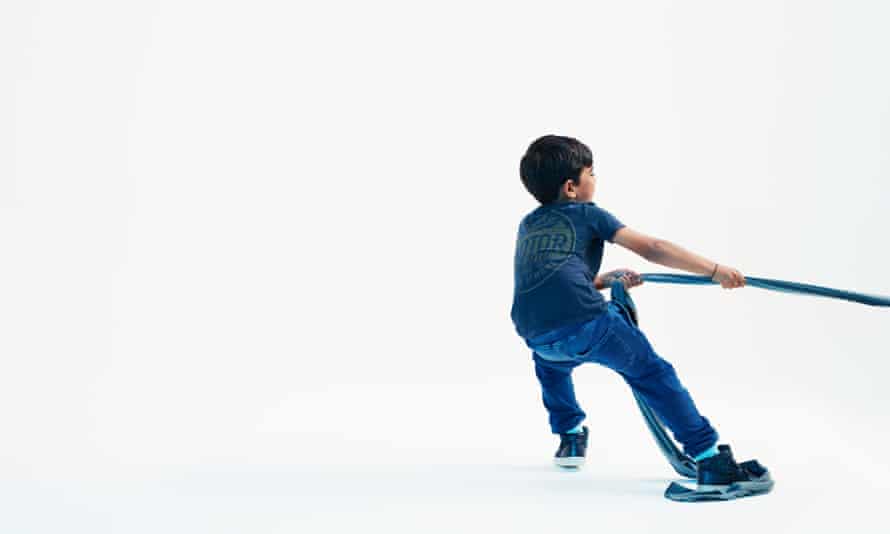
Since the 1980s, attachment parenting has evolved into a fully fledged school of thought, with official organisations spreading its give-and-take: Attachment Parenting International (API) in the Usa, established in 1994 by Lysa Parker and Barbara Nicholson, with the approval of the Sears; and Attachment Parenting Britain (APUK) in Britain, established in 2012 by Michelle McHale, a mother of two. And while information technology is still sufficiently niche in the Uk to consider itself, a little proudly, offbeat (followers refer to other methods as "mainstream parenting"), the approach is fast gaining traction. There are now 70 groups similar Rebecca'southward across the country, with an average of 15 mothers attending each. Lest anyone think this is largely a metropolitan tendency, the biggest group is in Wantage, as well in Oxfordshire. Derby has a thriving group, too, while those in London are relatively modest. Most people who follow zipper parenting practice not attend groups; they just know they don't desire to do things the Gina Ford style.
It is easy to see why attachment parenting is existence embraced in Britain. It takes adages familiar from NHS leaflets and gives them actress oomph: breast is all-time – for years and years; share your bedroom with your babe for six months – share your bed for as long every bit your baby wants. Two years ago, APUK won a grant of £ix,988 from the national lottery to "meliorate the wellbeing of families who access its services". British companies such as sling or reusable nappy manufacturers, and publishers of approved books – all of which have benefited from the trend – provide APUK with sponsorship; further money comes from the groups, which pay a ane-off fee of £200 for affiliation. When I speak to McHale on the phone, she tells me she plans to apply for another lottery grant, and to utilize the money to gear up free workshops around the country, teaching parents "to connect with their innate wisdom".
McHale, a full-time mother, discovered attachment parenting in 2007, when her first daughter was born. "She wouldn't become down [to sleep] and I researched baby-wearing and constitute it soothed her." She after learned her daughter had 2 heart defects that eventually required medical intervention, simply believes the baby-wearing helped. "It really worked. My second daughter didn't exhibit those behaviours, and then I might not have come to it if I hadn't had my beginning daughter."
And then why did she take the same approach with her second daughter? "Because information technology was simply then like shooting fish in a barrel," she says. "It felt right and natural." Since she established APUK, which now offers courses for parents wanting to apply the principles with older children, McHale says she has been regularly consulted by local social services nigh problem children. I enquire if she has a background in this surface area. No, she says, simply she has done an online form with the Us attachment parenting branch to authorize every bit a peer support group leader.
McHale is keen to stress that AP is not "this extreme thing". How would she describe information technology? "It encourages practices similar breastfeeding and co-sleeping," she says, "but I'd never say you have to do something. It'south not dogmatic. Information technology's about the quality of the relationship."
But isn't the underlying argument that the parents who don't exercise this, don't have adept relationships with their children? "I recollect a lot of mothers accept become disconnected from their instincts," McHale says. "AP supports women in what they instinctively desire. They want to carry their baby and wake up to them and feed them from the breast. Then let'due south back up them, and permit's support women who aren't doing it, but aren't happy with what they are doing." Like all parenting theories, this one generalises nigh what people want, merely with an added essentialist kicker: it assumes a adult female's instincts are to be attached.
A few weeks after our phone chat, I go to Exeter to meet McHale in a hotel restaurant, with four other mothers and their children. The five of the states talk over tea while the toddlers breastfeed and play in the sunshine.
I inquire McHale if she doesn't recollect some women only desire to put their baby in the cot at the terminate of the day while they take a glass of wine, instead of holding them for hours until they autumn asleep. She looks puzzled: "Well, I've met mums who were told by their friends not to choice up their crying babies, even though their instinct was shouting at them to do it. But they doubted themselves, and after felt the sadness of not responding the mode they wanted to." (The Sears accept gone much further than this, suggesting in their books that the only reason a woman might struggle with attachment parenting is because "your marriage was shaky going into pregnancy, or if you and your hubby were not really set". They also suggest that "women with a history of sexual abuse may find it difficult".)
There is no doubt that babies thrive when they are loved. But attachment parenting besides suggests that children who aren't loved in their prescribed way may develop serious problems. Barbara Nicholson, founder of API, tells me on the phone that she and Lysa Parker were inspired to co-institute the organisation when "we realised that kids with so-called learning disabilities actually suffered from fail, even from parents who securely cared only were post-obit the wrong advice. And when they got to school, they were given labels like ADHD [attention deficit hyperactivity disorder]."
Does she call up their ADHD was caused by non having an attachment? "I think the diagnosis stemmed from that. And then nosotros started giving parents simple communication, like, sit down with your children after dinner and read to them. They demand the connection with you."
Later, by e-mail, Nicholson suggests I write almost how attachment parenting tin assist with the "prevention of violence", referring specifically to Omar Mateen, who murdered 49 people in Orlando last month. "Information technology'due south and then disheartening to hear reports similar this and not go more in depth about what happens to kids who are marginalised and bullied and perhaps not receiving the back up and love they need in the home."
At times such as these, AP mutates into a class of parent-blaming – the downside of a theory that promises parents total control, and full responsibility, over how their kid turns out.
Julie, Sylvie and Martha are members of an attachment parenting grouping in northward London. They are all warm and sparky, and the loving bail they have with their babies is obvious. Sylvie and Julie both opted for attachment parenting because they liked it, or, more specifically, hated the alternative. For Martha, information technology was a reaction against her upbringing: she did not accept a close relationship with her parents and this, she says, "prevented me from forming attachments with other people until I found AP".
Like anybody else I meet, these women say they don't intendance what other parents practise, while at the same time describing sleep training equally "abusive". For Julie, co-sleeping is equally much for her as her eight-month-old son. "He's non ready to go into his own room, and I'm non ready, either. I similar hearing him breathe and knowing he's safe. I discover it difficult to mix with people who do sleep preparation, considering they go defensive. The judging goes both ways."
She'due south right: there isn't a parent who hasn't sought validation for their own choices by denigrating others'. But, at worst, "mainstream" parents volition look at attachment parenting and think it appears overindulgent, exhausting and unscientific. Attachment parenting, on the other hand, can invest its techniques with not just efficacy, just morality: if y'all don't do this, you are committing something tantamount to child abuse.
In my experience, most mothers regard their parenting skills with a mix of nervy insecurity and "That'll do, I judge" weariness; AP mothers, meanwhile, radiate a certainty that is either extremely seductive or a tiny bit annoying, depending on your mood. There is no doubtfulness they feel they have a special human relationship with their children, one Martha describes every bit "beautiful and amazing". Then there is the bond they course with each other: McHale had told me common back up was one of the main appeals of attachment parenting, and this was clear in every group I met. "Every fourth dimension I met with other mothers they were talking about their routines and information technology just didn't make sense to me," Julie says. "So I followed my instincts and it seemed to piece of work, but I felt I was doing information technology wrong. When I discovered other people were doing it this fashion, that was a huge reassurance."
Just in that location are times when attachment parenting seems to have made some women experience worse. Julie hadn't been able to breastfeed her baby, so bottle-fed him formula instead. "It'southward non traditional zipper parenting, and it does bother me," she tells me. "When I give him powder, I experience like I'thou letting him down."
She was about to return to work, with not bad regret. "I feel like I've done all this work, building my attachment with him, and now I've got to hand him over to someone else and information technology makes me feel sad," she says, looking down at her baby. While many women feel conflicting emotions when they return to piece of work, for Julie there is the extra guilt nigh what it will do to her "zipper" – something at in one case more tangible and delicate than the full general, amorphous feel of maternal love. Of the dozens of mothers I spoke to, only one had returned to piece of work full-time; Julie was the only one with a minor baby considering information technology.
I inquire Julie, Sylvie and Martha if they feel attachment parenting is a rejection of feminism. Absolutely not, they say, with the weary centre rolls of women who have heard this criticism before. "To say that yous have to go to work to be a feminist would be like saying being a feminist depends on existence a human being, completely denying the fact that we're different," Martha says.
When I heighten the issue with API co-founder Lysa Parker, she tells me she sees her arroyo as innately feminist. "When women who choose to stay home with children are criticised, it'southward some other style of keeping them down. So we see this as a maternal feminist issue. We should exist able to stay domicile for three to five years, without being ostracised by boyfriend feminists and the culture at large. What'south best for the female parent and child is what'south all-time for society, because if children feel loved, they'll abound upward to be adults who feel that way. People aren't looking at the big picture – information technology'due south all virtually the quick fix."
Sylvie had told me: "Feminism is about having choices, and that includes choosing to spend time with your babe." Just I wasn't certain if, with all the strictures AP puts on mothers, they felt they were exercising much choice. There are times when the underlying message sounds more like emotional bribery: subjugate yourself to your baby or else. It is absolutely correct to contend that a adult female who wants (and can afford) to stay at home with her children should do so; simply to advise the children of working mothers will grow up to be a threat to society moves this beyond "maternal feminism", and into rightwing demagoguery.
Although attachment parenting now appeals to the liberal, middle-class woman, it started from an anti-feminist place. As obstetrician-gynaecologist Dr Amy Tuteur details in her punchy new book Push button Back: Guilt In The Age Of Natural Parenting, the Sears are fundamentalist Christians with eight children; attachment parenting is modelled on their securely religious view of the family, with the father at its head and the mother the devoted caretaker. In The Complete Book Of Christian Parenting & Kid Care, the Sears write that "wives should submit to their husbands in everything… God has placed within mothers both the chemistry and the sensitivity to reply to their babies accordingly." (API's Parker says the Sears have since moved on, with the latest edition of their Attachment Parenting Book including a guide to being a working female parent – fifty-fifty if it still suggests women detect "employment that allows you lot maximum time to mother", and should perhaps "stride off the career rails".)
Tuteur tells me why she thinks AP is uniquely retrograde. "This is a movement that says, forget nigh educating yourself or working – all that matters is pushing a baby out and devoting yourself to information technology. Women, for and then long, only had birth and breastfeeding, and no 1 felt empowered. If y'all want to have ability from women, convince them they want to become back to that.
"The irony is that it appeals to accomplished women looking for some other means of getting validation. Children don't expect up and say, thanks for disciplining me or didactics me how to sleep. Attachment parenting gives parents a recipe they can tick off and say, "OK, I did it, I'thou the all-time, now they're fine." There is this idea that children are products and if you make the right input, they'll go upper-centre-class successes."
Tuteur also objects to the way AP speaks to a limited demographic. "Attachment parenting says a single Latina woman who works in Walmart tin't exist a skillful mother. So if only wealthy white women can be good mothers, there'south something wrong with this definition of being a mother."
A mother of four, Tuteur initially worked nights and then she could be with her children during the twenty-four hour period, and so switched from medicine to writing, over again to exist with them more. "There is nothing wrong with wanting to exist around your children. Only there is something very wrong with making your children your identity. That is not salubrious for anyone, and it appears nosotros are raising a generation that is helpless; their mother did everything for them, because that was her identity."
Back in Rebecca'southward home in Oxfordshire, the cake is half-eaten and more tea is existence fabricated. Rebecca, "an evidence-based hippy", has always wanted to practise better. She worked difficult at school and university, and after having her baby, dialled back her work at a veterinary practice to two days a week. She sharply corrects me when I say "office-time": she works full-time, because she's a mother.
Her little boy sleeps half the night in her room and half in his. She still breastfeeds him at 1am. Isn't she wearied later on a year and a half of cleaved sleep? "You just exercise what's best for them, don't y'all? I hateful, that's parenting." She shrugs.

The talk turns to co-sleeping. "My husband sleeps on the sofa, and that's his choice," says Liza, a babe-wearing consultant and mother of four who shares her bed with her two-year-onetime daughter. "The sound of my girl whining in the night woke him and we realised that, when he slept on the sofa, everyone slept better."
This cuts to ane of the biggest criticisms family unit psychologists have of AP: that it urges parents to privilege their children over each other. AP websites are full of advice about how parents can maintain their sex activity life despite sharing a bed with their children, usually involving alternative rooms and other times of day. (Several women tell me nearly the slogan "AP parents do it on the kitchen table".)
Simply family psychologists say this is not the point. Andrew One thousand Marshall, a marital therapist and writer of books including I Love Yous But You Always Put Me Last, points out, "When the dad is sleeping on the sofa, the female parent is telling him she has left him for the kids, and she is telling her children that they are more important than their father. I've noticed more and more couples struggling with this, but they're happier changing their partner than their parenting. Information technology'southward the one thing that's not-negotiable. Attachment parenting tells women to strive for a balance in family and personal life, but everything it then says undermines that. It definitely has more of an impact on couples than other kinds of parenting."
Anyone who claims their human relationship didn't suffer when they had a baby is someone whose pants are on fire. Just AP is especially intense: if both partners are fully signed up, fine; if 1 isn't, that can exist a trouble (and it's invariably the father; I did not encounter a single family in which AP was his idea). "My husband institute it hard in the beginning, when I was making decisions he wasn't expecting," Rebecca tells me, "and he wasn't always happy with the sleeping arrangements. We went through a period of struggling to communicate. Merely, with hindsight, he can run across all the decisions accept paid off."
Of my five friends who attachment parent, iii have separated from their partner. Obviously you tin't arraign AP for this; there were other factors. Just I ask McHale, herself recently divorced, how she thinks AP affects parents' relationships. "I recall mothers are often drawn to AP considering they are reconnecting to their instincts in a new style, and an inextricable by-product of this is the crystallisation of values. Parenting invites adults to know their values. This isn't unique to AP, but part of every couple'southward challenge to find a common footing."
Marshall sees information technology differently: "Attachment parenting is driven past a woman's enormous fear that she won't be a skilful enough mother. But these women demand to feel reassured that they will bond naturally with their baby, to have the humility to compromise with their partners and to remember they don't need to prove themselves all the time to other people. There's goose egg more destabilising for a child than their parents getting divorced."
I f the focus of attachment parenting is the children, in the end the real issue is how it affects them. Their arroyo, the Sears write, "builds kids who intendance. Because these children are on the receiving end of sensitive parenting, they go sensitive… I often watch AP children in playgroups. When friends are hurting, these children, like Good Samaritans, blitz to assist."
Over the past few months, I have also spent a lot of time watching AP children in groups. They were all – no question – happy, healthy and confident little people. Critics like to dismiss AP parents and their children as "needy mothers and clingy kids", but the kids didn't seem especially clingy to me. Nor did they strike me as significantly more than confident and happy than children raised the more mainstream way. Far from beingness paragons of empathy, I saw children kick each other, steal each other'south toys and generally bear as all toddlers do. For all the extraordinary endeavour these mothers made, the stop issue looked pretty much the same.
So who is attachment parenting for: the mother, the child, the conservative ideologues? I asked Liza in Oxfordshire. She is 37 weeks significant, has a 9- and an 11-year-onetime whom she raised the mainstream mode, including sleep grooming, and a four- and a two-yr-one-time being raised the AP style. The older ones, she says, do slumber better than the younger ones. "But slumber training only felt wrong to me and I wouldn't exercise information technology again. Although I'thousand so tired at present, I could slumber on a clothesline."
Does she meet a difference between her non-AP and AP children? She thinks for a minute, shifting her ii-year-old, who rests in a sling on her front, over her pregnant belly. "Well, some people would say this ane is more clingy," she says, nodding down at her daughter, "but I don't similar that word. Perchance carrying her made her clingy, or mayhap that's who she is – I don't know. But no, not actually. All my children are confident and vocal."
To outsiders, the attachment parent'south overt display of effort – the nonstop breastfeeding, the constant self-sacrifice – tin can seem an ostentatious declaration that they care much more than, a kind of performative motherhood. But increasingly, I saw something else, something more alike to female masochism in the pursuit of maternal perfection, a tranquility conventionalities that peradventure feminism had sold them a pup and staying at domicile with the babe wasn't just what they could exercise, but should do.
The thought that whatsoever i approach volition ensure a perfect lifelong human relationship with ane's kid will make all parents of moody teenagers snort, permit alone those with children who have more than serious problems. All children, even those with loving parents, even those with attachment parents, volition autumn down occasionally, experience lamentable, exist insecure, get angry, and that's not because they had bad parents – it'south because they're human. That parents should be involved goes without saying, simply the choice should not be between being an zipper parent and raising a failure. Later all, as Amy Tuteur says to me, "At that place are a lot of excellent means to raise children and information technology isn't the details that matter – it'southward the love." Names and some details have been inverse.
alexanderwipt1982.blogspot.com
Source: https://www.theguardian.com/lifeandstyle/2016/jul/30/attachment-parenting-best-way-raise-child-or-maternal-masochism
0 Response to "Dont Talk to Me of My Son Again Hippie"
Postar um comentário